-

- Find a Property
-
Sell
iconSell Your Property
- Agents
-
Explore
iconExplore
-
Blog & More
iconMarket Insights


April 21, 2026
3 Min Read
 484 Views
Building of the Week: 640 Park Avenue
By The Office for Metropolitan History
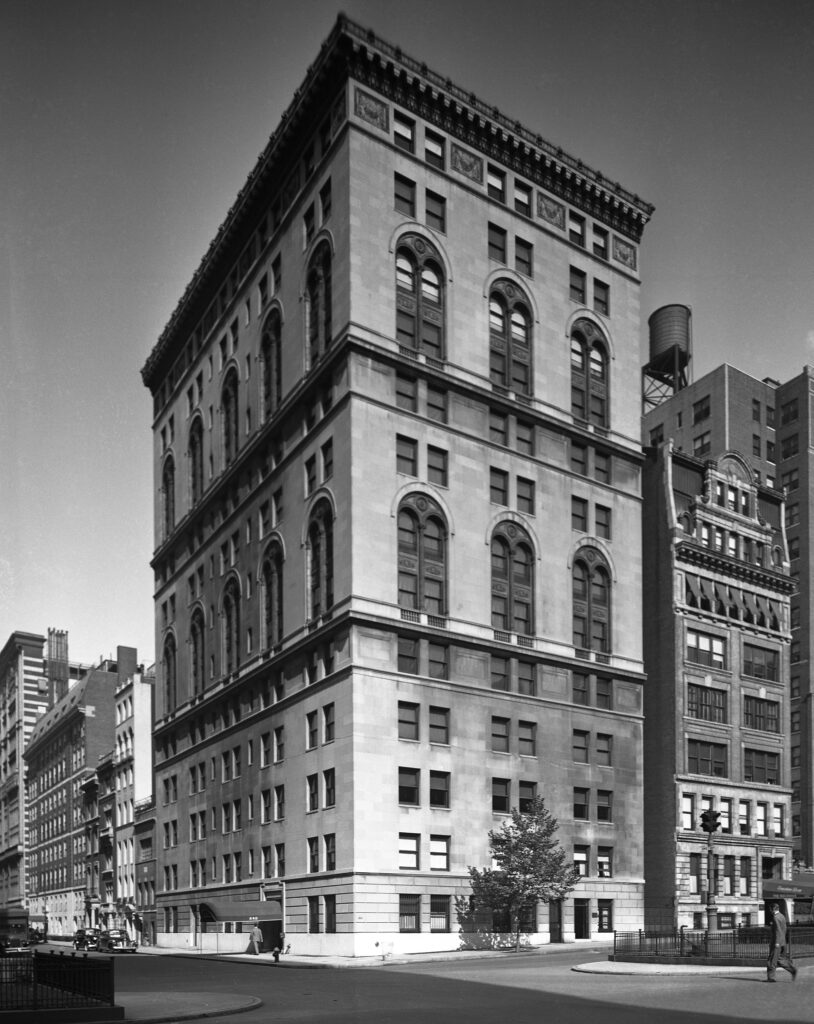
1942 photograph of 640 Park Avenue, from the collection of MetroHistory
Completed in 1914 and designed by architect James E.R. Carpenter, 640 Park Avenue represents a moment when the apartment house began to rival the private mansion. Its scale and floor plans were meant to provide the grandeur of a country house without the burdens of maintaining one.
Park Avenue itself had only recently emerged as a fashionable address. For decades railroad tracks ran along its center, with locomotives belching smoke and cinders into the surrounding streets. When the tracks were covered and the trains electrified in the early twentieth century, the avenue revealed itself as a broad, sunny boulevard just two blocks east of Fifth Avenue’s established “gold coast.”
Developer Spencer Fullerton Weaver quickly recognized the opportunity. Around 1910 he began building ambitious projects along the avenue, including 630 and 640 Park Avenue at 66th Street. When 640 opened it was marketed as a luxury rental at prices reflecting its ambitions. Full-floor apartments of 18 rooms rented for $9,000 to $12,000 a year, far higher than most apartments of the day.
Carpenter’s floor plans prioritized elegance over efficiency: the large living and dining rooms faced Park Avenue, maximizing light and views. Each apartment contained four family bedrooms along with extensive staff quarters, including six servants’ rooms. The arrangement reflected the domestic life of the building’s earliest residents, many of whom had moved directly from private houses.
Among the early tenants were members of prominent families such as George and Herbert Pratt, sons of Standard Oil partner Charles Pratt. Their lives also intersected with the larger events of the era: Alexander Thaw, a young aviator who lived in the building, made an emergency landing in Central Park’s Sheep Meadow in 1916 and was later killed in France during World War I.
Over time the building came to illustrate a broader shift in New York life. Wealthy residents who moved into apartments like those at 640 Park Avenue rarely returned to private houses in the city. The luxury apartment had succeeded.
More than a century later, 640 Park Avenue remains one of Park Avenue’s most distinguished residential addresses. Its limestone façade retains the quiet grandeur Carpenter intended. Up close, the stone reveals fossil traces of ancient marine life embedded in the limestone, a subtle detail visible to anyone who pauses along the sidewalk.
Today the building continues to represent the rarefied world of Park Avenue’s grand cooperatives. Its expansive layouts and classical proportions remain among the qualities most prized by buyers seeking authentic prewar architecture.
Within a few blocks are some of the Upper East Side’s cultural landmarks, including the Frick Collection, the Park Avenue Armory, and Central Park’s Zoo and Wollman Rink. 640 Park Avenue remains a reminder of the moment when the apartment house first became a mansion-like luxury without the bother.
Click here to view 640 Park Avenue, 9th Floor
More About Us:
MetroHistory is pleased to offer its services to Brown Harris Stevens brokers working with pre-war buildings. Founded in 1975 by the late architectural historian and New York Times columnist Christopher Gray, MetroHistory has long been recognized as New York City’s premier specialist in building research and document recovery.
Contact:
212-799-0520
Problems We Solve
- Help buyers make renovation decisions with historic blueprints: When clients want to blow out the wall between the living and dining rooms, we will find the blueprints that actually tell them what they need to know: where the beams, columns, and risers are.
- Help broker marketing historic listings: Add credibility and historic gravitas to your promotional material with original drawings, old photographs, and property history.
- Offer historic photographs as unique gifts: There is no more perfect gift for the proud new owner of a pre-war apartment than a historic photograph or drawing elegantly framed.
- Commemorate history with building reports for co-op centennial celebrations: For their upcoming centennials, boards of pre-war apartment buildings can engage our services to learn more about the history of their buildings and prepare for their next hundred years.
What We Offer
- Drawing Recovery: Locating original architectural, structural, and mechanical drawings.
- Historic Photographs: Access to a collection of 40,000 negatives and 18,000 photographs.
Building Reports: Synthesis of the literature review into a compelling story. Can be targeted for more specialized technical and legal needs.
April 21, 2026
3 Min Read
484 Views
Search Blog