-

- Find a Property
-
Sell
iconSell Your Property
- Agents
-
Explore
iconExplore
-
Blog & More
iconMarket Insights


July 7, 2026
5 Min Read
Why Overpricing Is More Expensive Than Pricing Below Market
By Jared Antin
The question almost every seller asks is the same: “What if we price too low?”
It’s a fair concern. No one wants to leave money on the table. But in today’s New York City market, sellers may be worrying about the wrong risk.
Recent research from UrbanDigs illustrates a reality we’ve long observed in Manhattan. Homes that entered contract within 30 days retained 100% of their original asking price. Even homes that took up to four months to sell still retained roughly 96% of their original list price. Then something changed. Properties that remained on the market for more than 120 days ultimately sold for just 91% of their original asking price.
The lesson isn’t that every home needs to sell immediately. It’s that the cost of overpricing can be far greater than the perceived risk of pricing strategically from the start.
Why Pricing Slightly Below Market Doesn’t Usually Cost You
One of the biggest misconceptions in residential real estate is that pricing slightly below market value automatically means selling below market value.
That’s rarely how competitive markets work. When a home is priced strategically, it attracts a larger pool of buyers, creates urgency, and increases the likelihood of multiple offers. Competition changes buyer behavior. Buyers move more quickly, negotiate less aggressively, and in some cases bid above the asking price.
In other words, pricing slightly below market isn’t about accepting less. It’s about creating the conditions that allow the market to determine the highest price buyers are willing to pay.
By contrast, overpricing often produces the opposite outcome. Fewer buyers engage. Competition disappears. Negotiating leverage shifts to the buyer. And when price reductions eventually become necessary, they’re often larger than the adjustment that would have positioned the property correctly from the beginning.
Buyers Don’t Compare You to Yesterday. They Compare You to Today.
One of the most common misconceptions about pricing is that it’s simply an exercise in determining what a home is “worth” based on recent sales.
In reality, pricing is just as much about competition as it is about valuation. Buyers aren’t making decisions based solely on what sold three months ago. They’re comparing what’s available today, what they’ve toured this week, and which property offers the best combination of value, condition, location, and lifestyle.
Your home isn’t competing against past sales. It’s competing against every comparable home currently on the market.
That’s why one of the most valuable exercises a seller can undertake is touring competing listings alongside their agent. Looking at your home through a buyer’s eyes often changes the pricing conversation. Where does your property stand out? Where does it fall short? And how does it compare in value?
Those are exactly the questions buyers are asking.
The Data Shows Where the Real Risk Lies
Based on research from UrbanDigs, for roughly the first four months on the market, Manhattan sellers retain most of their pricing power.
Homes that went under contract within:
- 30 days sold at approximately 100% of their original asking price.
- 31 to 60 days retained roughly 98%.
- 61 to 90 days retained about 97%.
- 91 to 120 days still achieved approximately 96%.
Then the curve changes dramatically. Once listings remained on the market for more than 120 days, the median sale price fell to just 91% of the original asking price.
That’s not simply a gradual decline. It’s a meaningful shift in negotiating leverage.
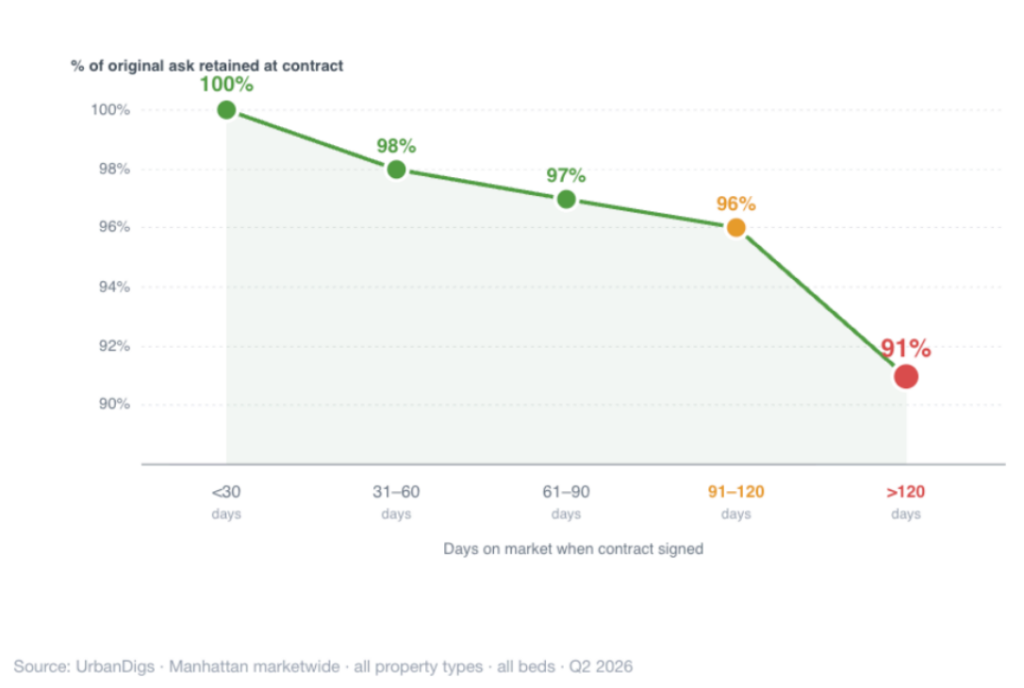
The takeaway is that if the market has consistently rejected your pricing for several months, continuing with the same strategy is unlikely to yield a different result.
Time Doesn’t Reduce Value. It Reduces Leverage.
The reason this happens isn’t that buyers suddenly become more aggressive. It’s because the psychology changes.
When a new listing comes to market, buyers wonder: “Should I move quickly before someone else does?”
Four months later, they’re asking a very different question: “If nobody else bought it, why should I pay full price?”
The property may not have changed. The market’s perception has.
Every additional week on the market gives buyers more confidence that they hold the negotiating leverage. Once that shift occurs, offers become more aggressive, negotiations can take longer, and sellers often find themselves accepting discounts that could have been avoided months earlier.
This is why I often say the biggest pricing mistake isn’t leaving money on the table. It’s leaving leverage on the table.
The Market Gives Feedback Long Before It Gives Discounts
One of the biggest mistakes sellers make is assuming they haven’t received meaningful feedback until they reduce the asking price. In reality, the market begins communicating almost immediately.
- Low showing activity
- Few second visits
- Minimal or no offers
- Limited online engagement
They’re real-time market feedback.
Too often, sellers dismiss these early signals because they believe the right buyer simply hasn’t arrived yet.
More often than not, the market is quietly saying the same thing over and over again: “At this price, buyers have better alternatives.”
Listening to that feedback early allows sellers to make thoughtful adjustments while their home is still perceived as fresh inventory. Waiting too long often means the eventual adjustment needs to be much larger because the seller is no longer overcoming just the price. They’re overcoming months of accumulated market skepticism.
Pricing Is About Managing Risk
Sellers often frame pricing as a choice between asking for more or asking for less.
In reality, that’s the wrong question. The better question is: Which pricing strategy maximizes the likelihood of achieving the highest final sale price?
Increasingly, the data points to the same answer. Strategic pricing isn’t about sacrificing value. It’s about maximizing exposure while your home has the market’s full attention. It creates competition, preserves negotiating leverage, and gives sellers the greatest opportunity to achieve the best possible outcome.
Because once that attention fades, recovering it is far more expensive than earning it in the first place.
In the end, pricing isn’t about proving what your home is worth. It’s about positioning it to succeed. And in today’s highly transparent, highly efficient New York City market, overpricing isn’t the safer strategy. It’s often the more expensive one.
July 7, 2026
5 Min Read
Search Blog